
Math anxiety affects roughly 20% to 25% of school-aged children. Many of us have felt it ourselves while sitting in class, unable to make sense of the numbers on the page before us. This panicked feeling is more common among teens, but it can show up as early as kindergarten. Even more concerning is that studies show math anxiety often has little to do with the numbers themselves.
The stress, racing heartbeat, and brain fog typically manifest in anticipation of the work, rather than the ability to complete it. Knowing this, we speak with Geillan Aly, the founder and CEO of Compassionate Math, to discuss what causes these feelings. She shared her insights on math anxiety, red flags to look for in children, and how parents can help children and teens overcome their fears.
What Causes Math Anxiety?

©MNStudio/Shutterstock.com
It's a common misconception that math anxiety stems solely from the stress of completing math work. Studies have shown that stress arises from the anticipation or negative beliefs about the process itself. Several factors can exacerbate this feeling, including a child's environment, past experiences, and comparisons with other students.
Aly has seen this time and time again and offered to share her own observations on students with math anxiety. When asked why math is so intimidating, she says there's a lot to consider.
“There's no one answer for why this is, but there are several factors, and each affects us in different ways,” she says. “Math is a hard subject, there's no doubt about it. That, in and of itself, may intimidate some students. Thinking mathematically means thinking very deliberately and systematically, and for someone who isn't used to thinking in this way, it may be very hard and intimidating.”
“Moreover, for too many students, math is taught without meaning and context. Students don't often get the chance to see the ‘why' in math, and so every problem turns into a meaningless set of steps, devoid of context or beauty.”
Aly explains that without the larger meaning behind the math, a student can feel intimidated because they don't know how to approach a problem. “You see this when a student will claim a question is a trick question, or the teacher didn't teach them how to do the problem,” she says.
“Math for these students turns into a strange, meaningless set of recipes to follow. Add to all of this that math is a very high-stakes subject. So much of our future depends on how well we do in math class in school, and that raises the stakes and our feelings of anxiety even higher.”
Anxiety Over Math Is More Than Just Numbers
When it comes to math equations on paper, the problem isn't always critical thinking. In Aly's experience, math anxiety is stress over everything that comes along with math. “The issue isn't necessarily working with numbers, but all the consequences that come from it. Math is a natural human endeavor. Human beings are mathematical beings, so it's not the math itself that is intimidating. It's more about all the ‘gunk' that goes with learning math,” she says.

©pics five/Shutterstock.com
When a child feels pressure to perform or experiences adverse reactions to wrong answers, this affects their feelings toward a subject. This can turn math into a vulnerable learning process, one that Aly compares to feeling overwhelmed.
“I often put it this way: imagine doing something with extremely loud music blasting in your head. You can't think clearly. It's not necessarily the content that's hard; it's all the noise around it,” she says.
What Are the Red Flags for Math Anxiety?
Math anxiety is a scary thing for a child, and it's equally concerning for a parent. There are several red flags to watch for if your child shows apprehension toward the subject. According to Aly, avoidance is the most significant warning sign. “A red flag would be a child who avoids math. If a student doesn't want to do their math, then the parent should try to intervene,” she encourages.

©South_agency / Getty Images
“Math anxiety isn't always a bad thing. Math is an important subject, so getting a little nervous because the stakes are high or the work is important is natural. When being nervous, scared, or intimidated starts to affect the student adversely, the parent should seek help for their child.”
Another thing that parents should be aware of is their own attitude toward math. According to Aly, research shows that math anxiety can also be passed down from a parent to a child.
Keep Math in a Positive Light
“In my opinion, the earlier parents start to normalize math, using math, and thinking mathematically, I would say the less likely the student will develop math anxiety. If math is a normal part of life, it won't be a scary boogeyman that kids need to fear. With that, parents have to be VERY careful about how they talk about math. There is research to show that parents with math anxiety will ‘pass along' their anxiety to their children,” Aly tells us.

©PeopleImages.com – Yuri A/Shutterstock.com
Children are observant and can pick up on how their parents feel about math. “If a parent talks about ‘not being good in math' or [says] ‘math isn't for us' or ‘I can't do math,' then their children will internalize these feelings,” she explains.
“But if a parent says ‘math was hard, but I worked at it and I was successful and you can too' or ‘I'm not sure how to do this math problem, let's figure this out together,' the child will have a completely different impression of what math is and how capable they are and can be in mathematics.”
How Math Anxiety Complicates Learning
The biggest challenge many students face when learning math is actually the belief that they can't. In Aly's experience, many children believe math isn't in their wheelhouse, further reinforcing the belief that it's something they can't learn.
“Most of the students I've worked with seem to hate math and think that they're not ‘a math person.' When I talk to them, they have what I call math trauma, previous experiences that make them not want to engage in math. And yes, this, sadly, is extremely common. I have a four-step framework that I use to help students work through their math trauma,” she says.

©PeopleImages.com – Yuri A/Shutterstock.com
Aly explains that this is when she takes time to listen and put their experiences into perspective. By removing feelings of shame, it's possible to show children that they are talented mathematical beings.
“I have yet to meet a child whose mathematical skills did not surprise me, or them,” she says. “Once we get into the math, I take the time to explain the ideas to the child. Oftentimes, they were never taught or never had the chance to consider the bigger, deeper ideas in mathematics. Once they see that math makes sense and that different ideas are connected, the sky opens up, and they get more interested in the math.”
How You Can Ease Your Child's Math Anxiety
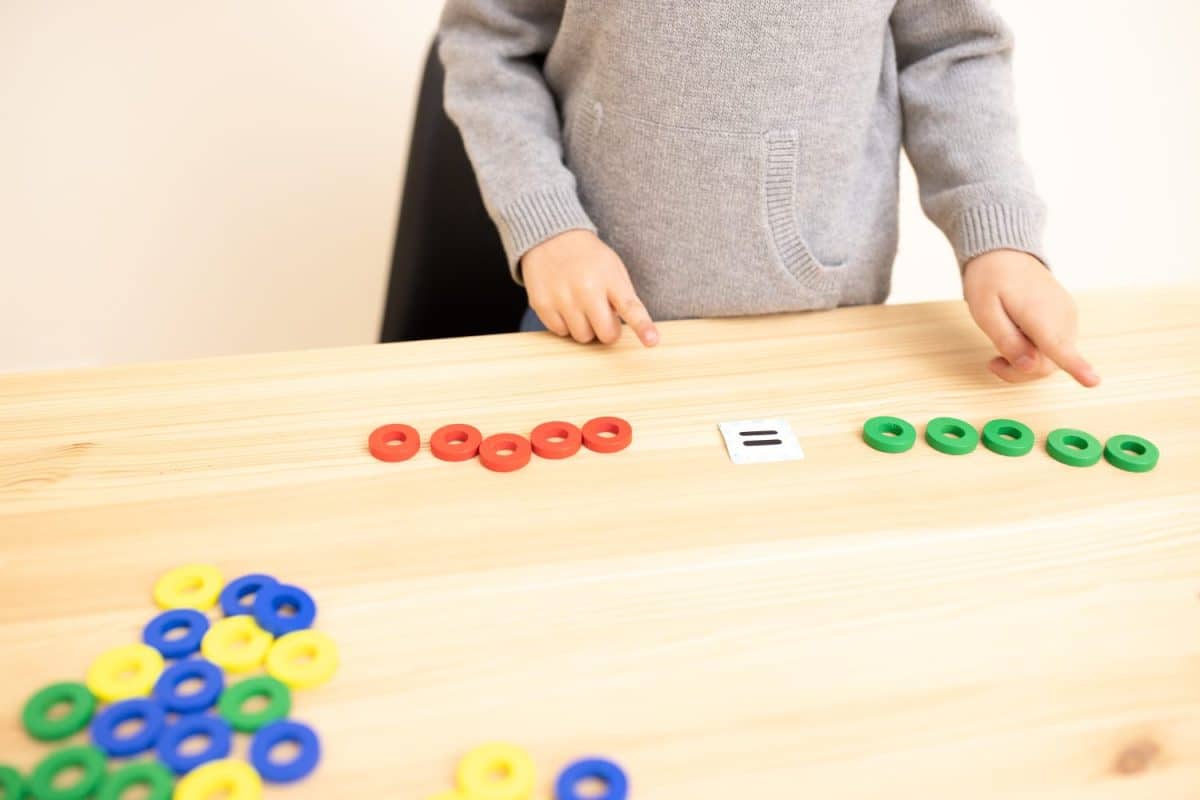
When it comes to changing how your child sees math, Aly says the answer is simple. “Make math fun. Play math games, do puzzles, and show the student that they are capable of doing math. Also, take the time to look for math in your world. It's all around us,” she says.
“You can do easy things, like talking about fractions when baking, or go for a walk and try to find as many different shapes as possible. From there, allow the conversation to grow. For example, discuss what is the same or different about a square, rectangle, or diamond you saw on your walk.”
©Larysa Dubinska/Shutterstock.com
Aly adds that for older children, discussing budgets or questions they're interested in that could be answered using statistics, such as sports, is an excellent space for this discussion. She also stresses that she's not a clinician, but has seen where math anxiety comes from.
“Many fears are tied to catastrophizing and the unknown. Once kids get a feeling of control around the content and their abilities to do math, they are likely to feel less anxious. I also conducted a small pilot study in which students meditated at the start of math class for a semester. The students' math anxiety went down significantly!” she says.
Tricks and Tips for Parents Dealing with Math Anxiety
Thankfully, there are several tools parents can use to address math anxiety. Along with familiarizing children with math at a young age, parents can also make it fun. “Math games for sure. But also practice. That's the thing about math that many people don't understand. There has to be a certain amount of drilling and practice that's done to gain new skills,” Aly suggests.
“Math is an active subject. It is learned and mastered by doing math. But be careful when there's frustration. If a child is stuck and having a hard time working through 5-6 problems, there's no reason to force them to keep going. This is a point to stop and get them help or switch up how they're looking at the problem.”

©fizkes/Shutterstock.com
Aly also recommends avoiding shortcuts when solving math equations. “I also STRONGLY recommend taking away the calculator and AI. Math is all built on making connections,” she says. “We don't see those connections if they're made for us. The foundations of these connections are number sense, and that doesn't develop using a calculator. Think of number sense as your mathematical spidey sense. The way to grow your spidey sense is to spend time doing calculations until you get comfortable.”
Geillan Aly, CEO and founder of Compassionate Math
“Math is a human endeavor. It's something that is innate in all of us. Math has always been a tool humans have used to solve our problems. I promise you that if your child becomes successful in mathematics, the joy and satisfaction they will feel internally will be far greater than anything you can do. We've seen what happens when a child feels a deep sense of accomplishment. Nothing can top it! Seeing the beauty and connections in math satisfies the deep human desire to satiate curiosity.”
The image featured at the top of this post is ©ESB Professional/Shutterstock.com