
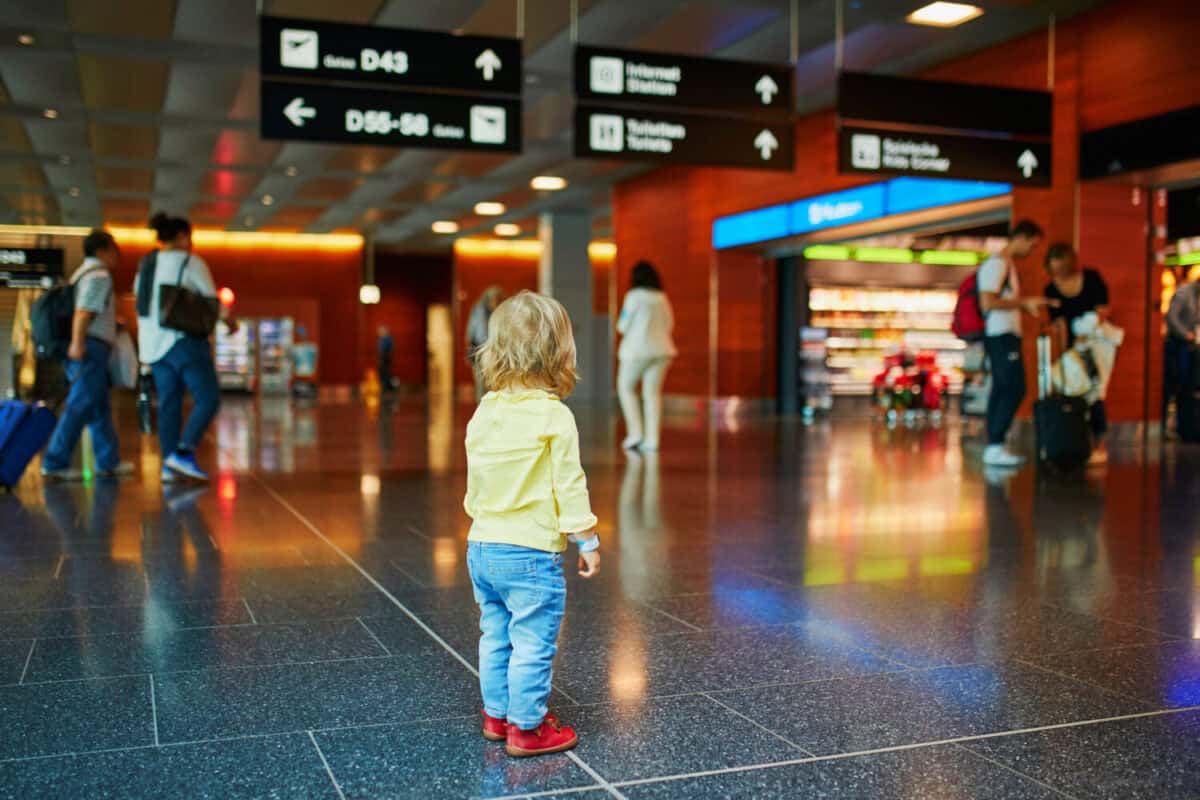
Losing your child in the crowd is a parent's worst fear realized. There's no greater panic than when you lose sight of the person in the world who matters the most. And this terror is felt on both sides. No parent wants their child to know what it's like to feel lost, but unfortunately, it does happen. The only thing to do is be aware, prepare, and ensure you and your family have a plan.
We speak with Julie Waite, Co-Founder of Streetwise Defence and host of the podcast Self Defence for Women – Live an Empowered Life, to learn what safety tips we should be teaching our kids. Waite is a women's safety advocate and self-defense expert who shares how she protects her own family.
The Reality of a Child Getting Lost
©Ekaterina Pokrovsky/Shutterstock.com
More moms have experienced their child getting lost than you realize. Stories, like the one from this mom on Reddit, are all too common. And if there's anything to remember, it's this: It's not your fault. This mom found herself in an impossible situation when her daughter was accidentally bumped in a crowd at Disney. Although she was only lost for a few minutes, it was enough to spook both her and her parents. Thankfully, with the help of another mom and a bit of backtracking, the family was reunited. But for many of us, the trauma stemming from this fear comes from our own experience.
“I have experienced many unfortunate and upsetting incidents in my life, as many women have. Including sexual assault, street harassment, and sexual harassment in the workplace,” Waite shares with us in a personal moment. “And day-to-day, I used to experience that low-level fear of ‘what if.' What if someone follows me, what if someone breaks into my home, what if someone attacks my children or me?”
Waite explains that not knowing what to do in those situations left her feeling vulnerable. “It was only when I met my partner, Dene, and he taught me self-defense that these feelings changed to ones of confidence and empowerment. And that is why together we want to share this message with as many people as possible. It really is life-changing and potentially life-saving,” she says. And this is also what allows her to empower other parents, especially moms, on how to keep their kids safe if they get lost.
Don't Let the Fear Control You
“As a parent of two girls myself, the thought of one of my children getting lost makes me feel physically sick. It is honestly one of my worst nightmares, somewhat reinforced by my own experience of getting lost as a child in Disney World,” Waite says, words that resonate with the recent story on Reddit.

©Rawf8 / iStock via Getty Images
“I was 10 and went to look at something, and when I turned around, my family was gone. I can’t remember the details. Only that it felt like ages before I found them, and the sense of panic and dread that gripped me then has stayed with me ever since. And that has motivated me to never lose my girls.”
Waite tells us that one of the best things about being a parent is making magical memories together. “This will inevitably involve having adventures where there is the potential to get lost. If you talk openly with your children about getting lost and put a plan in place that you reinforce and stick to, this shouldn’t worry you or stop you from living your best lives,” she adds. The plan, she says, should start with open — and frequent — conversations.
Talk About the Plan Until It's Memorized
“Preventing a child from getting lost starts with open conversations and age-appropriate explanations. So every single time we go out — and I mean every time — I have the same conversation with my girls,” Waite shares with us. Her plan always begins the same way: with an explanation of where they're going and what they'll be doing.
“Today we are going shopping. It will be busy, and there will be lots of people. It is important that you stay next to me and don’t wander off. Do you know why?” Waite says. “Explain that you don’t want them to get lost because it could be very upsetting and scary for them. And you may want to mention that, ‘there are also some bad people who might want to take you away from me.' Most children will not want to get lost after that explanation, and will naturally want to stay close to you.”

©Zulfiska/Shutterstock.com
From here, Waite emphasizes the importance of “standing still” until a parent finds them. If they don't, there's a chance parents and children might miss one another. “Stand still in the same place for as long as it takes, and I will find you. Stay calm, I will always find you. If you see me and want to shout at me, then shout my name rather than mum,” Waite says, reciting what she tells her own children.
“The point of them standing still and you looking for them is super important. If you are both running around trying to find each other, you could easily miss each other. It is a very simple thing for them to remember: just stand still. And in doing that, it helps them to feel calmer,” she says.
If An Adult Offers Help
Another potential scenario to prepare children for is what to do if an adult talks to them. It's not uncommon for adults, especially other parents, to recognize a lost child and try to help. “If any adult, even a police officer, offers to help, tell them this: ‘I lost my mum, but she told me to stand still, and she would find me. She told me not to go off with anyone. You can stand here with me until she comes, but I am not to move,” Waite says. “This prepares them in advance for anyone who may be pretending to help but with bad intentions.”

©Nicoleta Ionescu/Shutterstock.com
She adds that this can even be taken a step further. “If you want to take this to an extra level of safety, you could say that if anyone tries to drag you or carry you away, you are to shout ‘he’s not my dad' or ‘she’s not my mum', rather than to cry or scream,” she shares, acknowledging this thought might be scary but is a crucial safety practice.
“The key to this plan is to repeat it every time you go anywhere and get your children to repeat it back to you. I have had this conversation with my girls thousands of times. And on the odd occasion where they have been out of my sight for a second, I have found them standing still scanning around for me,” Waite reassures.
Understanding Stranger Danger and Other Tips
“Stranger danger” is still very much relevant, if not more so, in 2026. Children should always be taught the dangers of walking away with someone they don't know, and Waite emphasizes this. “They can ask for help, but they must understand that they are never to go off with anyone, even a police officer. They must stand firm on that,” she tells us.
Parents may consider GPS devices or phones a first line of defense, but this isn't always foolproof. Waite adds that in a world where digital communication can fail, standing firm on the plan in place is equally important. “Technology can break, phones can run out of battery, and there may not be a reliable signal. Sticking to your plan is the best course of action, and if they can phone you to say where they are, then that is a bonus,” she says.
©Fly View Productions / E+ via Getty Images
Lastly, some level of fear isn't a bad thing. “The main thing that will stop you getting separated is the explanation you give your child about why you need to stick together. You don’t want to scare them too much, but a healthy dose of fear is required. Otherwise, they could be blasé about safety and strangers,” Waite shares.
“It is possible to explain the dangers of getting lost, but in a way that your child isn’t terrified. I know because I’ve done it thousands of times. My tip is to have the conversation on the way to the event. At that point, you are all excited. Give your explanation of why you need to stick together, reiterate the plan, get them to repeat it back to you, and then change the subject to the fun things you will do together.”
The image featured at the top of this post is ©Andrew Angelov/Shutterstock.com